Imperialist Geography

People ask me what it means to be a geographer. Most people think of memorizing state capitals. I tell them I make and study maps, I also tell them about Tobler’s law : everything is related, closer things are more related than distant things. For my thesis, I wrote about Afghanistan, a country whose fate is determined by its physical and cultural geography.

Saying your’e a geographer or a cartographer makes you sound like a British Orientalist from the 19th century, but until American stops behaving like 19th century Britain in its foreign policy we’ll still need cartographers:

Apple Maps – Old News

*I’ve decided to change my blogpost day to Monday and shorten the posts while I’m in school.

It’s been a few months since Apple announced it would they would create their own map app, no longer relying on google maps. I’ve linked to a few articles below. I read somewhere (I can’t remember where) that apple has hired real cartographers to run their maps department while google hired computer programmers. I’m curious to see how this turns out.

With the advent of GoogleMaps everyone became an amateur cartographer. But in order to make maps that display more specific information you need to be able to use a program like ArcGIS and you need some rudimentary knowledge of programming. Is this a problem? In my Human Computer Interaction (HCI) class we’re learning that it is never the User’s fault if they can’t get something to work. Is it okay for some fields to require specialist knowledge? Why/Why not?

On a personal level I’m trying to figure out if it’s worth it to learn enough about computers and programming to write my own programs or whether I just need to learn how to use the crappy existing ones well enough for my needs.

Gossip

How bad is it to gossip? I’ve always felt that it was pretty bad. It’s not technically against the commandments, nor is it a cardinal sin, but it is decried in most religious texts and seems morally suspect. It also seems anti-feminist, not because we’re gossiping about women necessarily, but because gossiping is such a cliche thing for a girl to do. And I generally try to be better than that. I’ve been on the wrong side of bad gossip so I know how much it can hurt.

But after all this I must admit that I love to gossip. I love knowing secrets, and having the power to tell someone. I love taking the knowledge and putting it in my own words. I love the camaraderie it brings, when you both are in the inside.

I saw someone today who I hadn’t seen in a while, and I wanted so hard to gossip about her, but there’s something just as great about keeping good gossip to yourself. Even when the facts are correct, and it’s something I would feel comfortable saying to the gossippee’s face, you can tell when it’s news, and when it’s gossip, and there doesn’t seem to be a right way to do it. I don’t consider myself a gossip, but in the company of certain people (high school friends especially) I can get carried away. I’ll try to keep resisting this urge, even if the action gives me pleasure, since it does seem particularly vile and hurtful.

I memorized this sonnet in high school (I didn’t want one about love), seems applicable;

‘Tis better to be vile than vile esteem’d,
When not to be receives reproach of being;
And the just pleasure lost, which is so deem’d
Not by our feeling, but by others’ seeing:
For why should others’ false adulterate eyes
Give salutation to my sportive blood?
Or on my frailties why are frailer spies,
Which in their wills count bad what I think good?
No, I am that I am, and they that level
At my abuses reckon up their own:
I may be straight though they themselves be bevel;
By their rank thoughts, my deeds must not be shown;
Unless this general evil they maintain,
All men are bad and in their badness reign.

Sonnet 121 William Shakespeare

Albért the turtle

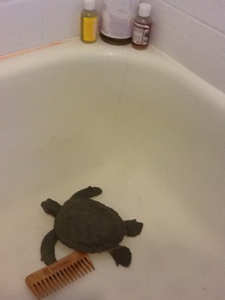
I keep meaning to introduce you to Albért, my turtle. I got Albért last summer at some point, and named him after Alber Elbaz of Lanvin. Don’t you think they look alike?:

From thegloss.com


Anyway, we’re moving this weekend. He’s lived in this bathtub for a year, among the Dr. Bronners.

20120825-073519.jpg

What a house; my, she was yar. But it’s onward and upward from here.

On Criticism

I wish that I could tell you that it’s all alright
Glass of the Microscope – Yeasayer

I like to think that I’m all about tough love and hard truths. When it comes to self awareness, everyone has their blind spots, and I tend to think that it’s the job of a good friend to help you see them. I think if someone asked you whether you wanted to know the thing that was holding you back, almost everyone would say yes, they want to know what their thing is. But not everyone wants to know, even if they say they do. Harsh criticism is hard to take, especially from a friend (a good friend of mine sent me a critical email 3 months ago that I’m still processing it).

When it comes to harsh criticism, what are the exceptions, is it okay to criticize the dead? is it ever okay to tell someone you don’t like their art? In a way, since you’re not criticizing their person, but something they did, it should be easier. But in our culture, art is such an extension of someone’s personhood that it’s never really appropriate.

There has been a spate of articles about book criticism lately, on one side is Slate’s case for more critical critics and Dwight Garner for the New York Times Magazine, while Laura Miller at Salon and Heidi Julavits at the Believer make the case against harsh criticism and snark in their field. Miller argues that there should be an exception for fledgling writers, people don’t read that many books anymore and it does more harm than good to squash these new authors before they get their bearrings. While Julavits argues that no one should review a book until they write one (To hear a great wrap-up of the debate check out the Slate Culture Gabfest). With art especially, there is a particularly vile type of criticism that says ‘this isn’t even art‘. There are certain contexts where it’s considered a matter of taste, and others where it isn’t. I think I tend to be on the side of hard truths but I think it’s not a coincidence that the call to be harsher is coming from men, and the call to be nicer is coming from women. This isn’t because women are thin-skinned and can’t take criticism, I think it’s because they know what it’s like to be on the outside in an industry that still privileges men’s opinion.

Let’s look at criticism in a field I know a little more about. I’ve never wanted to be a writer or a literary critic, but I love music and particularly music analysis. It’s no secret that my favorite band of the past 10 years is Yeasayer. I’ve been anxiously anticipating their new album which dropped this week. The album was panned by Spin and Pitchfork, two of the most respected music magazines. Reviews matter (someone once told me something about the Beach Boys that has tainted almost every listen since), you internalize other peoples’ tastes and they become your own. But what are these magazines really saying? Maybe pitchfork’s reviewers are as racist and sexist as their readers. Yeasayer’s may be too gay for them. I had a friend who wrote reviews and someone criticized him for referring to many albums as ‘the best I’ve heard all year.’ He stood by his statements, arguing that music doesn’t hurt, if you listen to an album once and don’t like it, it’s not the end of the world, you didn’t waste any time, no harm no foul. I agree with Julia Turner on the Gabfest, you don’t have to listen to every album, (or read every book), be discerning in what you review, then you can be as harsh as you want.

It struck me on a second listening to the Gabfest that this can also be framed as an East Coast vs. West Coast Debate. Although born in Boston, Dave Eggars has become a distinctively West Coast literary figure, as has his magazine McSweeny’s is one of the few major magazines published in California and NOT New York. It’s a classic debate between the straight talking New York art critic and the laid back California surfer/stoner/hippie. Coming from Oakland, I feel it’s the best of both worlds, it’s sunny California for sure, but maintains its urban grit and certainly a diversity of opinion. I like to think this represents my views, I can take the harsh truths but only in the warmth of the supportive sun.

p.s. Apologies to the Russian’s Mom, no wedding pictures, just decided to go meta.

Discrete Math Concepts

I’m taking a test tomorrow, so I’m going to use this post to help me study. So this post isn’t so much what I have been thinking about all week (I’ve been out of town for a wedding), it’s what I should have been thinking about this week. It’s also an experiment in talking about math and technology using words (If you find math boring, feel free to read someone else’s blog). I’m taking a class called Discrete Math, most people don’t know what this is (I didn’t either, before I took the class). Discrete Math is a requirement for most Computer Science students, it’s a jumble of math concepts that apply to computers including Logic, Algorithms, Set-Theory, Graph Theory, Combinatorics and Number Theory (here’s a video intro if you’re curious). It’s not discreet meaning hidden or restrained, it’s discrete; meaning distinct and separate. Discrete math deals with numbers that you can count, as opposed to Calculus which deals with infinity and continuity. It’s my understanding that computer’s can’t deal with infinity, they will just count and count until they run out of memory or power. They can count pretty high, but they’ll never get to infinity.

I’m almost done with the course so I can share some of the things I’ve learned and how (I think) they apply to Comp Sci. First we went over some basic logic, we thought about how to convert English sentences and arguments into logical symbols, how to test the validity of an argument and also how to use truth tables. How to convert spoken language into symbols is helpful, but to me the clearest application of logic to computer science is the use of truth tables. Truth tables are manipulations of true (T) and false (F) values, if you substitute 1 and 0 for T and F, you have classic binary values that computers can read. A bit is a boolean string of length 1, it just tells you whether something is true or false, on or off, black or white.

Next we studied basic sets, and equivalence relations. Sets are essentially primitive databases, in fact, a csv file, that you can open in excel, is just a set of numbers or strings (csv stands for comma separated values). Proofs and relations help us to define exactly what is in a set and how sets relate to each other. These laws determine how to manipulate data; a lot of it has to do with what things we consider to be equivalent. It’s really important for computers to know whether something is the same or not. Things that are the same can be grouped with other equivalent things, they related to themselves (reflexive) and others in a certain way (symmetric and transitive). Equivalences set the parameters for a computer’s sense of discretion, it helps computers to discern and judge like things from unlike things. To me, this is what makes computers ‘smart’, the fact that they can distinguish one kind from another (maybe someday they’ll be able to tell good from bad, right from wrong).

In the second unit we looked at sequences, sums, induction, algorithms, and number theory. Here we took a basic look at the different ways to tell computers what to do, and how effective they are. For a set you can input each entry separately, or you can populate an entire dataset by defining a function, and saying everything in that sequence is in the set. There are two main ways of defining sequences, you can define the first term and have a rule from there (recursive), or you can define it abstractly (closed set). Mathematical induction is a type of proof that uses the same idea as a recursive set; it says if you can prove the first idea and then say that the second idea is implied by the first idea everything else falls into place. I understand this in theory, but I had a lot of trouble with this in practice, it tends to use a lot of algebra I haven’t used in a while.

Next we looked at algorithms. My teacher says ‘Algorithms are a recipe to solve a problem,’ an algorithm is a series of steps which when followed will solve a certain type of problem. For example we looked at the Euclidean Algorithm to solve Greatest Common Factor problems. To apply the concept of algorithms to my programming class an algorithm is like pseudocode. One way to write a program is to start with pseudocode, it’s like a very detailed outline. You write out a line of code saying, for example, “if a < b, switch b and a". The code in JAVA would look something like if (a < b) { a=b; b=a;} In another programming language it would look different, but the algorithm or pseudocode could be the same. In number theory we looked at how integers interact with each other, the Rules of Arithmetic (addition and multiplication are closed, commutative, associative, have identity, inverse and multiplication distributes; there is an ordering relation and a divides relation). Using these rules we are able to find primes and come up with a division algorithm. These types of rules would be very helpful if you were trying to build a calculator, and what is a computer but a giant calculator?. My test is on the second unit so I'll have to go over some induction examples, and also memorize the formulas for recursive sequences and the rules of arithmetic. p.s. As if it didn't take me long enough to learn how to spell rhythm, now I have to learn algorithm?

Zula Forthrast

If you’ve been reading my blog you know that I’m starting a masters in computer science and I’m trepidatious about it. I’ve been trying to read up on the subject, but other than textbooks, I’m finding that most computer science reading lists include a bunch of sci-fi, which (along with computer games) really doesn’t interest me in the least. Which is why I was surprised when someone recommended a Sci-Fi novel to me because there was a character who he thought was a lot like me. I don’t see a lot of people like myself in books, especially not sci-fi. The book is Reamde, and the character is Zula Forthrast. An Eritrean orphan, adopted by a family in Idaho, with a degree in computer science and geology. She wears heavey-rimmed glasses and rocks a “hyperspace-librarian girl-geek” style. The book is really long, and seemed to be mostly about a MMORPGame so I opted to listen to the audio-book, trying to follow this interesting character and learn about the culture and science of computers along the way.

The author, Neal Stephenson, has written a lot about computer science, including an amazing essay on operating systems called ‘In the Beginning there was the Command Line.’ Like his essay, this books is jam-packed full of ideas about computers and where technology is headed. The plot got way too convoluted way too fast for me, but it was well-written enough that I was compelled to finish it.

After the brief introduction I was excited about this badass Zula, (and flattered that someone thought she was like me). But I ultimately felt like she was just another fetishized sci-fi girl, sprung from the brain of a man (there was particular episode involving a tampon that made me question whether any woman had even read the galley). I didn’t really get a chance to see her in action as a computer-geek before a convoluted plot whisked her off to China and then Canada on strange pretenses (I don’t think it’s giving anything away to say that the reader had his work cutout for him with accents including, Irish, Welsh, Russian, Hungarian, British, Arabic and Chinese). All in all I’m glad that she exists as a character, but left the book ultimately disappointed by the execution of her character.

That’s not to say there wasn’t anything interesting about the book, like I said before, the book is chock full of knowledge. Zula was still an extremely interesting character, and there are some really interesting things about computers and gaming culture. Zula’s uncle Richard helped create a computer game called T’Rain. The game is unique for two reasons, one economic and one geographic. The economic one is that the game takes two distinct gaming cultures into account, the Western cultural paradigm, where consumers spend money to be entertained (real money becomes virtual money) and the Asian one, where people game for a living (virtual money becomes real money). The other thing that makes the game stand out is its geophysical accuracy, one of the other founders created the game mostly because he was tired of how inaccurate the landscapes were. This is where Zula comes in, working with the geophysics experts and game designers to make striking and realistic landscapes. These two characteristics make the game extremely profitable.

I glimpsed a slice of the gaming culture through this book. Most of which I found repulsive and uninteresting, but some parts I found intriguing. Throughout the book T’rain is undergoing a ‘War of Realignment,’ which the game’s fake historians are chronicling as they go. The origin myth was a fairly basic Good vs. Evil story, but overtime this shifted into a new-school (Forces of Brightness) vs. old-school (Earthtone Coalition) battle. It’s essentially aesthetic, someone posted a way to hack into the settings so you could give yourself a blue mowhawk, and many people decided change their characters to brighter colors, while originalists chose to keep the more old-school, traditional gaming look. In this way you can track people by their color palette, the gaming company hires a colorist to keep track of palette shift, who is wearing what, and what this means to the world. So fashion plays a surprisingly important role in this book.

I’d say the most prevalent narrator of the book is Richard Forthrast (Zula’s uncle), we spend more time in his head than anyone else’s. Like many older American men he has a few ex-wives. These women live on in his brain as a sort of conscience which he refers to as ‘the furious muses.’ They tell him to exercise (he does all his computer work on the elliptical machine), eat well, and do the right thing. Towards the end of the book he reaches a point where he needs to do something traditionally crazy, but the furious muses encourage him. I really related to the idea of your conscience telling you that you need to put your conscience aside for a minute.

Anyway, I don’t know if I can really recommend the book, some parts are great, some parts were awful, and it’s exceedingly long. But if you like this kind of thing, then you like this kind of thing (and you’ve probably already read it).

Romantic Movies

As kind of a response to my most recent anti-love rant, I wanted to write about about two of my favorite movies that happen to be romances; Polish Wedding and Heaven.

I’m a foul cynic, and I’ve always had a hard time resolving this with the fact that I am also a senseless romantic. Both of these movies are love parables, and there is a sense that love catches up with these women, a sense of inevitability. Though I really love these movies from an aesthetic point of view, I must admit that I also love the romance them. These are both stories of strong women who stand up for themselves, and aren’t defined solely by their surroundings (or their men).

Hala (Claire Danes) in Polish Wedding is a wild-child daughter of a Polish family in 60s Detroit. Her mother is the strong, sexy matriarch Jadzia (Lena Olin). The plot centers around Hala and Jadzia, not particularly the father Bolek (Gabriel Byrne) or the 4 brothers, who all sort of blend together. It’s a story of Hala’s sexual awakening, Jadzia’s unquenchable sensuality and how they both meet with traditional Polish values. The movie culminates in the Procession of a Virgin towards the end of the movie. I don’t think it gives anything away to say that someone’s virginity is called into question.

Heaven is a Krystof Kryzlowski film (Decalogue, Red, White and Blue), directed by Tom Tykwer (Run Lola Run, Princess and the Warrior). It’s the story of Philippa (Cate Blanchet) and Filippo (Giovanni Ribisi). Philippa, frustrated by the inactivity and corruption of the Italian police (carabinieri in this case), commits an unspeakable act in the first scene. Filippo is a police officer and also her translator who falls in love with her. (slight spoiler) The story is about how they have to work together to evade the law. Like Polish Wedding, it’s a story of a woman surrounded by men, officers, guards, Filippo and his father and brother.

These aren’t strictly traditional love stories because neither Hala, Jadzia or Philippa is really in love with their husband (or lover), but all three heroines need a man’s help for different reasons. Hala and Jadzia need financial help while Philippa needs a guide and confidante. All 3 men react differently to being put in this utilitarian position, Russell (Hala’s lover) resents the truncation of his youth, Bolek (Jadzia’s husband), hates waiting ‘like a dog’ for his wife to return from her Polish Ladies’ Club meetings, but Filippo seems honored to be in this strong, exotic woman’s presence. In a way, they are all love stories without love, though all the women learn to love overtime.

One interesting thing I noticed, watching these movies in tandem, is how aesthetically similar they are. They both deal in a similar palette, with blonde heroines, rolling around in pastures, walking along traintracks, confessing in vaulted churches and wearing uniforms. In both of these movies it’s really only children, and the heroines who don’t wear uniforms. It creates a very stark contrast where Philipa and Hala can really stand out as unique in a sea of men who all sort of look the same (Jadzia uses her cleaning lady shirtdress and Polish Ladies club uniform to stand out in her own way).

Both of these movies have really kick ass soundtracks. Polish wedding’s Luis Bacalov sountrack features a fairly whimsical melody played alternately on accordion, clarinet and finally sung by a children’s choir, keeping the film light and humorous. Heaven features a powerfully minimal soundtrack by Arvo Pärt which makes every backdrop feel like a cathedral. As Arvo Pärt says in this masterclass, ‘The soul yearns to sing it endlessly.’ I think that can be said of both soundtracks, and also both movies. With melodies that seem familiar and settings that feel dateless, Polish Wedding and Heaven are both timeless fables, I’m sure I will continue to watch them anon. If you don’t like them, that’s cool, we don’t really have to be friends anymore.

Problems. As a black woman it’s a little dissappointing that there are no colored characters in either of these movies, but it would seem forced if there were. The movies both deal with nationalism and ethnicity in a way, it’s just that Polish people and Italian people don’t have dark colored skin. As a feminist, I’m not even sure Polish Wedding passes the Bechdel test since Jadzia is always talking about the men in her life and Hala is always talking to the men in her life, but there might be a conversation between Jadzia and her daughter in law that doesn’t mention either of their sons or husbands.

The Extent of the Rights of Man

I got into a really dumb internet comment argument this morning and it made me think of freedom of speech and the rights of man. America was founded on the idea of the ‘pursuit of happiness,’ but what about the situations where your happiness can affect someone else’s? To what extend are we allowed to pursue our own happiness to someone else’s detriment?

I was talking about this to a friend of mine who is a philosopher, he said this conundrum can be solved easily, just insert the caveat that ‘as long as it’s not hurting anyone else.’ In our overpopulated world, though, I don’t think it’s quite so simple. As someone for whom sleep is very important, I always think of loud music as an example, at what point is it a nuisance? Loud music makes the listener happy, a good nights’ sleep makes the sleeper happy. Who gets to pursue happiness? The original listener or the one trying to sleep?

What if you’re an artist and your art is painful to other peoples’ ears? Can you say words that are mean? How mean can they be? Can you say racist things if they are true? What if you’re a racist and you don’t know it? What if your happiness comes from a sexual fetish that involves consent? or children? What if your traditional food is prepared in a very smelly way (looking at you, KimChee)? What if what one person thinks is a compliment, you take as an insult?

These are things that you can do to be happy, what about things you’re not even conscious of doing? What if you smell bad? What if your body is so deformed (or attractive) it makes people uncomfortable or distressed? What if your speaking voice is so loud it hurts (sensitive) people? Where is the line between discomfort and pain?

In a way, this is minutia, but I also think it’s extremely important. These issues come up all the time, and they will come up more and more as the world’s population increases. I’m sure the founding fathers didn’t really have to deal with their neighbors loud music, they could just pitch their tent in the empty space a mile away. We don’t have that much empty space anymore. In fact, I can’t really think of a situation where you can pursue happiness without affecting other people in the process.

I realize it’s a privilege that I get to write about these things and I want to take a moment to appreciate that I have these freedoms and I have the right to talk about them, and question them. Not everyone has these rights, as intimated in the recent Ai WeiWei documentary (haven’t seen it, just heard them talk about it on the gabfest)

Feel free to comment if you have any answers, these are just questions.

love as destructive force

It’s takes no strength to be a cynic, and I don’t harbor illusions that it’s courageous or noble. But right now this is how I feel, and these are my thoughts and I promised myself I would write these down once a week. Indeed this week I seek to record these thoughts because I fear they might change, and I need to record how I’m feeling now so I can mark my progress in the future, when I might finally grow out of my adolescent views on love.

Love is one of the most destructive and dangerous forces we know. Yet people celebrate it rather than fear it. I’m not talking about what happens after love, heartbreak, divorce and death being its common aftermath. And this isn’t a bros before hos rant about the friends left behind when you pursue your own happiness and spend all your time with a significant other. I’m talking about how love itself is force, producing just as much evil as good.

As a teenager I was discouraged from using the word hate, they said it was too strong, and added unnecessary negativity to the world; but I observed that people are encouraged to use the word love, even overusing it. Most people agree that love and hate are two sides of the same coin, but when we chose to focus only on the one side we forget the other (I feel it is just as important to know how it feels to be hated for no reason as it does to be loved, unconditionally*). I believe that all love can be re-read as hate, its equal and opposite reaction. It seems that much as your are attracted to the things that you love, as much as you want to protect them, this is how much you are disgusted by things you don’t love, and want them to disappear. Every attraction has a reaction.

For many, the ultimate culmination of love is sex, whose ultimate end is a child. People say they love children because they are full of potential, but it’s this potential that scares me. As much potential as a child has to do good, so have they to do evil. Children are the ultimate agents of chaos. Bringing extreme joy and extreme sadness with them, and leaving love and frustration in their wake.

When a person loves another person, this is celebrated, but many will agree that a love of objects can be destructive. People say this love is ‘unhealthy’ and ‘unnatural’. But there’s a reason why we use the same word, love; the feeling is the same. I posit that it’s not the object of love that’s the problem, its’ the act of loving which corrupts relationships. I don’t believe that love is a universal salve, bringing Goodness to everything is is applied to. I’m not arguing that love is not transformative, love changes things, it changes the subject and the object. But change isn’t always good. I think my point here is just that love is dangerous and that people should use discretion around it, not blindly follow it wherever it takes them.

*When I was younger I felt it was my responsibility to hate those I who I thought had never been hated. It’s embarassingly presumptuous to pretend to know what someone else has, or has not felt before. But when you’re a teenager, you think you know what’s best for everyone.