Works in Progress I: So I Had this Idea for a Show

I’m toying with the idea of creating a podcast. As an avid podcast listener the idea of putting my hat in the ring is daunting but also exciting. My idea is to talk about music. I know that getting the format right is important and updating on a schedule is key. My ambitious* idea is to have one song (or piece) a week: once a month the song would be recent (a term I’ll define later) and once a month the song would be ‘classical music’ (again, something I’ll define later). I would feature guests to talk about certain pieces, including people I know in musicology departments, musicians and I know, as well as other family and friends. We would use the music to talk about other things, for example:
the Star Trek Soundtrack
-theramin history and usage
-autism and race
Amadou and Miriam
-World music/African music market
-disability
Beck – Song Reader
-“slow music movement” (like slow food for music)
-history of parlor music
-Beck and Scientology, does it matter?

I have no idea how long such a conversation might last, I’m thinking maybe 10-30 mns. This is my example script/notes for a Star Trek Soundtrack show.

Introduction:
Guest (I have a certain UCLA musicologist in mind for this some)
Some questions:
Are you a Star Trek Fan? How did you first come across the franchise? Which is your favorite series?

Body:
What was your impression of the soundtrack?

The original Star Trek theme is known for being an early use of the theremin (though according to Wikipedia it wasn’t). The theremin is an early electronic instrument named for its inventor Leon Theremin. It is recognizable for its use in sci-fi soundtracks.

Star Trek the original series is also known for its progressive treatment of race (the first interracial kiss on TV!). The crew featured all the major ethnicities, Sulu representing Asians, Uhura for Africa, Chekhov Eastern European, Scotty, Western European, Kirk, America (I guess). What struck me watching the movie now was how short-sighted this view multicultural view was. In the future all races will work together, in equality, but they won’t reproduce with each other? There were no mixed-race characters. Weirdly, Khan seems to represent a multi-racial Asian, dissecting his full name Khan Noonian Singh you might get, Khan: Central Asian, Noonian: Middle Eastern, and Singh: South Asian (YES I realize this is total racist speculation, that’s how Roddenbery seems to Roll). The Khan as terrorist Osama Bin Laden analogy seems too easy so we won’t talk about that.

In addition to the diversity on earth, the original series featured a representative of an extraterrestrial race with Spock the Vulcan. It was interesting to me how Vulcan tendancies were very in line with the autistic spectrum. Autism is having a moment in America, according to the PSAs, 1 in 50 children will develop autism. Some possible causes I’ve heard are: assertive mating, high income, computer culture, and vaccines, etc.

Conclusion:
In conclusion, don’t see Star Trek for the music, it’s not that great. And frankly, the movie’s not that great either, but I was entertained throughout. I hope you were just as entertained by this conversation.
This has been — podcast, with our special guest —– —–
Shouout to — (probably my mom, who will be my one listener)
you can find more information at the website (which I’ll create) etc.
Outro

Let me know if you have ideas for titles, sponsors, words of wisdom/warning, etc.

*I know this schedule is extremely ambitious, especially since I haven’t been able to maintain a schedule for this blog lately, (and I’ve been unemployed!) but I think once I get started it will easier to maintain.
Queens of Black Bohemia

Some of my favorite podcasts are the Culture Gabfests with music critic Jody Rosen. I’ll never forget his comments from a podcast 3 years ago that there’s a hunger in black bohemia for heroes. I am always on the lookout for the new heroes of black Bohemia. Here are is a playlist of black bohemian queens to tide us over for the next big thing, in roughly chronological order:

Nina Simone


Phoebe Snow:

Zap Mama:

Lauryn Hill:

Les Nubians:

The Noisettes:


Santogold:

Janelle Monae:


Left off Eryka Badu, Sade, Jill Scott, Grace Jones and others. But interested to hear what others think.

9/4/2013 Added Laura Mvula:

Thanks to Slate Culture Gabfest.

Things that made me cry

This is a list of things that have made me cry in the last month or so:

I had originally thought to put the list in order of what should have made me cry but I don’t think such an order exists. I am trying to be kinder to myself about being a highly sensitive person. Recognizing that I am part of a larger group (20% of individuals) who share this genetic trait and that there isn’t anything wrong with it.

This feels related to this post from around this time last year.

Gymnastics Montages

We have a deadline at work and I’ve realized that my current favorite form of stress release is gymnastics montages. Here are some of my faves:

A sassy intro to gymnastics from the movie Stick It:

An artful training compilation from same:

The wonderful French gymnast Elvire Teza on my favorite event, beam:

(If you can’t understand the French, the trick performed at 0:14 is named after her. I just couldn’t tolerate Elfi Schlagel’s comments in the American version)

5 beautiful and artistic beam routines compiled by MostepanovaFan:

A great compilation of difficult and interesting beam mounts:

And who can forget Wei-Wei’s breakdancing beam routine:

When the movie first came out the late Roger Ebert remarked that this skill could only be achieved with special effects. I don’t know if (or how) special effects might have been used in this movie, but I am confident that with a dedicated gymnast and enough time and takes, a girl can do a headspin on a beam. Rock it Wei Wei.

Grace

Growing up we used to say grace before every dinner. I’m not sure when or why, but we stopped. Maybe it was after my mom broke up with her boyfriend or after my brother went off to boarding school, probably some point in between. We used to have cards with graces from different traditions. We had blessings we chanted in Hindi, humorous English ones, short ones, long ones. Even at music camp we always sang a blessing before lunch and dinner, a popular favorite being ‘My Plow (Brings me Happiness)’.
Last year when I was in Afghanistan our host seemed surprised that someone as polite and well-mannered as myself hadn’t the patience to say grace before eating. I was out of practice, I’d like to get back into it. It’s a moment of meditation in our busy day. A moment to acknowledge the privilege that, unlike most people in the world, I don’t have to worry about where this meal will come from. Grace is Good.

‘Privilege is a headache you don’t know you don’t have,’

-Ani Difranco

Thanks to Dom for reminding me @6:40:
http://vimeo.com/46696697

Aesthetics and the Mark of Cain

I once took a class where we studied monsters and early geography. Our teacher argued that the reason Americas Most Wanted publishes pictures of criminals is that we like looking at faces for signs – we want to know that we can recognize a criminal just by looking. This curiosity is as old as the bible, wherein God marks the first murderer for all to see. We look for outward signs of inner demons, particularly on the face.

The irony here is not just that we can’t judge character based on facial features, but that if I we were to do so, the only thing I know for certain is that the most beautiful people can get away with murder (though not literally). It’s the beautiful people who don’t have to do as much, they don’t have to be smart or clever to be treated well. I hold beautiful people to a higher standard because they can coast because most people see no blemishes in the outside and assume there are none in he inside.

Which brings me to why I have trouble with looks-based compliments. When someone says you’re hot they’re saying you’re worthy of attention. They may or may not believe that because I have a cute face, I’m good on the inside. I’m not saying I’m not worthy of attention or that I’m not good on the inside, but the stranger giving me the compliment doesn’t know (and if I really am as good looking as you say, I probably don’t need to be good on the inside). Unlike Mindy Kaling, who argues in her recent book that a man should compliment how you wear the item (your body) rather than the item you’re wearing, a man after my heart would compliment my fashion sense. I can’t really help what my face looks like, but I can chose the glasses I put on in. For me, that seems to get a little bit at what’s between the ears.

entitlements

“They were all four of them providing a service for the rest of the people in the café, simply by being here. They were the “local vibrancy” to which the estate agents referred. For this reason, too, they needn’t concern themselves too much with politics. They simply were political facts, in their very persons.”

Zadie Smith, NW

My new place is a lovely treehouse in the hills surrounded by paths and trails and wilderness. It reminds me of a friend who grew up around here, when she moved to a more urban area said she missed running the trails in the evenings. One of my roommates this semester said she missed swimming in the pristine ocean, saying ‘not having the ocean is like not having carrots.’ I felt these people were being unappreciative, just because you grew up in a particular way doesn’t mean that it’s better or worse than another place, you can take a bus to the ocean or take a walk to some trails. When you grow up in nature, you gain a lot, but you miss out on a lot to, it’s often harder to access culture, but most importantly to me, you miss out on diversity.

I recently read Zadie Smith’s new book, NW and it reminded me of the a lot of racial issues around geography and urbanity. One thing I appreciate about Zadie Smith is her insight into middle-class black life. I don’t envy my mother’s cohort of educated black (often single) mothers who had to chose between raising a child who grew up in the comfort of an urban area around black people (knowing her roots), and the extreme discomfort of being the inkspot in a richer, whiter neighborhood. My mother chose to make our home in a middle-class neighborhood that was very mixed racially, and send us to schools where my brother and I were often the only people of color in our class. I think it worked out great for us, but I don’t envy people who have to make such difficult decisions.

People who grow up in urban centers, projects like the ones described in NW, have to deal with the realities of poverty, criminality, lack of access to education, and all that this entails. But people who grow up as the token brown person have to deal with the realities of not being represented in the culture that surrounds them and the pressure of representing their entire race and class, a pressure I’ve been feeling a lot in my job lately. The weight of that burden is difficult to describe for someone who has never experienced it. I know it’s not my responsibility to teach everyone what black people are like, but when I’m the only brown woman on my team, there is added pressure to perform. I carry this burden on behalf of my generation (people think millenials are lazy), for my locale (people think Californians are lazy), for my race (people think black people are lazy), for my sex (people think women aren’t smart, and can’t do science), for my family and for myself. A friend of mine was telling me how fun it is to act crazy sometimes, frankly I don’t think I have to luxury of lunacy.

I listened to the Slate Audio Book Club on NW. On the podcast they discussed the character Keisha, a black woman who grew up in the projects and became a successful lawyer. She was my favorite character in the book and the one I related to the most. The people on the podcast seemed to believe that the character could never really be successful. That she was bound to fall from grace in a way. I don’t think she had a dramatic fall from grace, but I also don’t think such a fall is so inevitable. In any case, I liked the book, and the discussion and I’d highly recommend both.

Growing up where I did I was surrounded by a diverse group culturally, socio-economically, and ethnically. I’ve written a little about this before but as I’ve lived and moved to other places I have found that this is very important to me (and that such a mix is pretty much unique to Oakland). But it brings up the question, what are we entitled to in a home? Is what your parents had good enough? Is what you had good enough? are you entitled to the same experiences as your peers? do you need wilderness to breathe free? do you need to live with both a mother and a father? do you deserve your own room? How much culture are you entitled to and what?

NOTE: I have started a new job (see resume) and don’t have much time to blog. It’s probably gonna be more like once a month from now on.

Healthy Infrastructure for Single People

One idea in our society that I find prevalent and destructive is the idea that being in a romantic relationship is a sign of mental health. I resent the idea that everyone should be involved in a romantic relationship, but especially the idea that people who are in these relationships are somehow healthier than those of us who aren’t. I’ve found, based on completely anecdotal evidence, that my friends who were raised by single mothers are more likely to share the point of view that ‘until you’re comfortable living alone, you’re not ready for a relationship.’ But even people with this philosophy ultimately tend to think that once you get yourself correct, you’ll be ‘healthy’ and ‘ready for a relationship,’ as if there’s some sort of equivalence. The idea is that once you establish a romantic relationship you’ll be happy, have kids and in doing so become a healthy, contributing member in society.

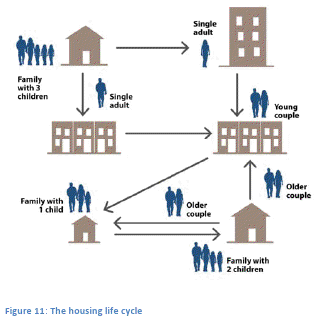
The idea is so prevalent that our society lacks the infrastructure to support single people as well as single mothers. Architecturally the places created for single people are not thought of as permanent; rooms in apartments, studios, 1-bedroom apartments, in most places, (even cities), these living situations are thought of as temporary while stand-alone houses are considered permanent. We tend to think, ‘I’ll live in this apartment until I get married and we start a life together and buy a house’. The lack of urban density and smart-growth is in part fueled by this American lifestyle that says you grow up in a house, you live in an apartment in your twenties, you get married and start a family in your 30s, buying a house, and you hold onto it until you die1. This biographical timeline is so common and so ingrained that most don’t even notice it enough to question it.

The reason I find the idea destructive is not only that in discourages smart-growth, but that it discourages the development other types of relationships. Relationships with close friends and family are back-burnered in favor of romantic ones. It privileges sexual relationships over asexual ones, and often encourages a type of co-dependency that can be much more unhealthy than independence. In fact, I always thought, growing up, that people in relationships were weaker than people who weren’t. Now I can see that there can be health in romantic relationships and that independence is not always strong (and never truly independent). It’s not black and white, and neither is life, but when there is one vast and prevalent idea I think it’s always helpful to question it.

1Housing Life Cycle

From Rapid Fire White Paper, Calthorpe Associates.

Junot Diaz on Pigment Politics and Decolonial Love

I’m re-posting this excerpt from Junot Díaz, at the Facing Race 2012 conference in Baltimore 11/15/12 with some transcriptions I did.

On Pigmentation Politics – 6:45

“What was my process like in identifying my own systems of oppression? That’s actually a wonderful question and conversely difficult. … I think what’s interesting about that is how many of us are aware of the strange and agonizing systems that both invite us to tyrannize other people and that help to tyrannize us. I think for me, belonging to a family of 5 young immigrant kids of African descent, from a poor Caribbean family, the first step in this process was noticing how clearly and how nakedly privilege got distributed in my family across racial and gender lines. Which is to say my family was like a really fucking weird experiment in pigmentation politics. Where the bizarre fiction of eliding light with lovely really was practiced superbly well in my family. So that the lighter siblings of the five, [people] were always like ‘you guys are so beautiful, you guys are so nice, you guys are so amazing,’ and they even received less punishment than the rest of us who are considered more racialized. And then of course this gets complicated [by] gender was also, in my family we were split between brothers and sisters.

“And for me I think one of the first steps in this idea was both how I noticed this system very early on, but also how greedily I attempted to profit from it. Because it’s one thing to point out when somebody’s trying to put a foot in your ass, but usually most of us, while that’s happening we’re trying to put a foot in someone else’s ass. And I noticed that I was at the receiving end of this sort of stuff, but I was also really kind of gleefully practicing it. And I know the consequences of that in my family, 5 kids, each of us a year apart, really tearing each other up along those lines. A lot of the pain and the damage, a lot of the treachery, a lot of the cruelty, this followed us into our teenage days and became not only a source of tension, but when we got older a way that we began to talk to each other.

“And listen guys, when you’re that close in age and that close in family, if you grew up like we did where you stacking 3 kids to a bedroom, it forms part of your conversation, it’s hard to run from that, though people can. And I think the kind of ways that I hurt my little sister, the kind of ways I betrayed her, the kind of ways that I sort of projected a lot of racial and hetero-normative and masculine shit on her in a way that really hurt her, and the way that it kind of deformed her childhood. And both of us growing up with the consequences of that, her more forcefully and palpably but me more as someone who had spent a lot of time victimizing her. I think those are the roots of when I think about working and it becoming clear that one has to do a lot of internal work to really get anywhere in this world especially if one who’s really interested in racial justice of any form. I think usually most of the groundbreaking occurs inside of you, I think of that when I think of it. Yeah, it’s tough.”

On De-Colonial Love – 20:45

“What links most progressive people …to the most rabid right wing lunatic is how gleefully we exercise our privileges. The funny thing about our privileges is that we all have a blind spot around our privileges shaped exactly like us. Most of us will identify privileges that we know we could live without. So when it comes time to talk about our privileges we’ll throw shit down like it’s an ace and that shit is a three! I understand that. You grow up and you live a life where you feel like you haven’t had shit, the last thing you want to give up is the one thing, or the couple of things that you’ve really held on to.

“I’m telling you guys, we’re never going to fucking get anywhere—if you want to hear my apocalyptic proclamation which I would never repeat, but which I know you motherfuckers are going to tweet about—we are never going to get anywhere as long as our economies of attraction continue to resemble, more or less, the economy of attraction of white supremacy.


via Racialicious